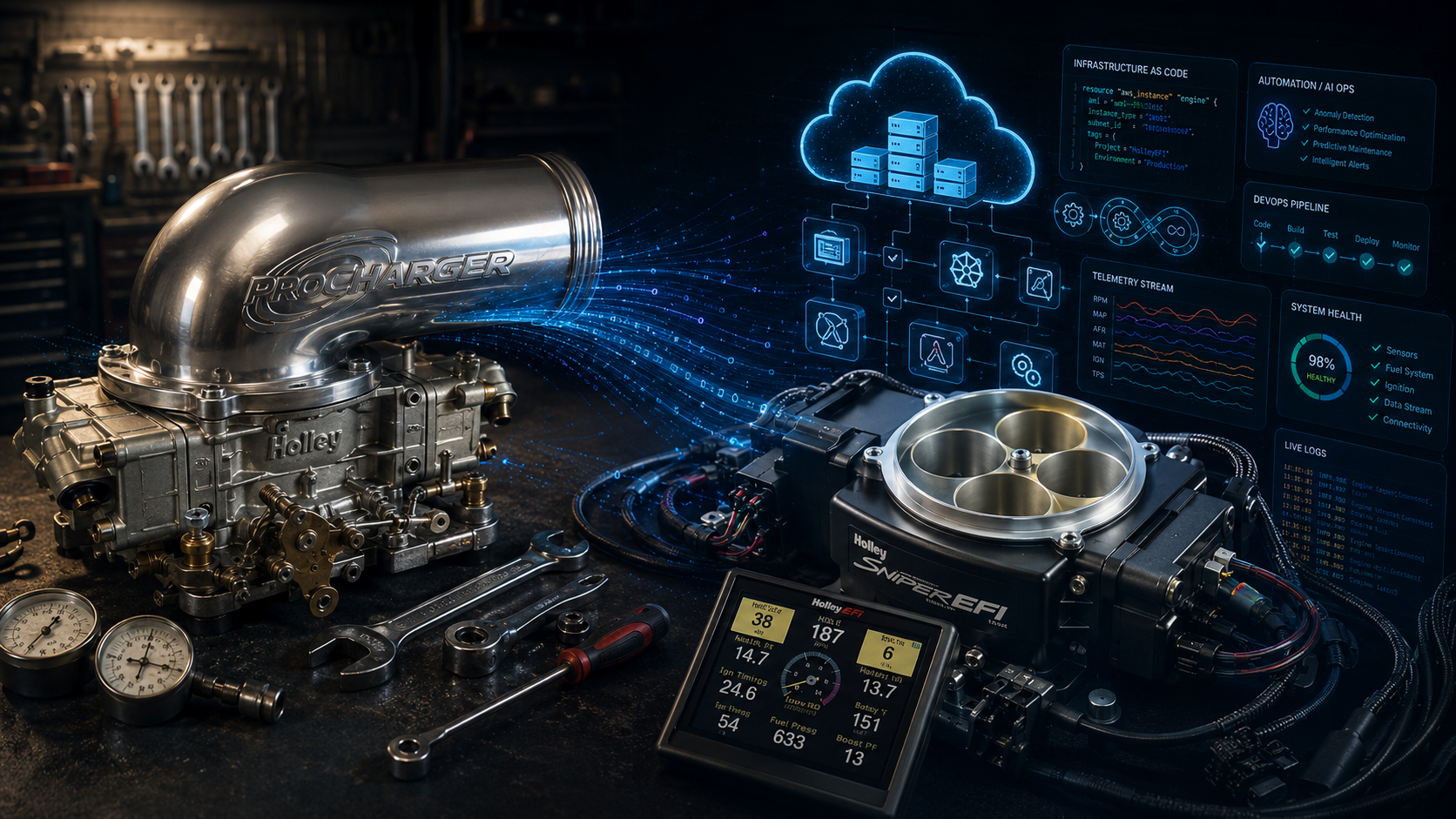
I have been thinking a lot about carburetors lately.
Not because I want to go backward. I don’t.
I have been thinking about them because the move from carburetors to EFI in racing feels a lot like what is happening right now in infrastructure. We are moving from things we could touch, feel, adjust, and fight with by hand into code, workflows, automation, AI agents, and systems that work off feedback instead of guesswork.
That sounds abstract until you have lived both sides of it.
I am a hardware guy. Always have been. Hands on. Rack it, stack it, wire it, fix it, take it apart, put it back together. I understand that world because I can put my hands on it. I can see the cable. I can hear the bad bearing. I can smell when something electrical has had a bad day.
That kind of work gets into your bones.
So when people start talking about infrastructure as code, AI agents, pipelines, DevOps workflows, and agentic coding, I understand why older infrastructure people hesitate. It feels like the control moved somewhere else. It feels like somebody took away the screwdriver and handed you a screen full of strange words.
I get it.
But I have seen this movie before.
In racing, we used to fight carburetors constantly. Weather changed, the car changed. Temperature changed. Altitude changed. Track conditions changed. You were always tuning, adjusting, trying something, backing it out, trying something else. If the car was not happy, you had to work your way there by feel and experience.
There was craft in that. I am not taking anything away from it.
But you could not tell a carburetor the end state and expect it to go make that happen. You had to create the end state manually, one adjustment at a time.
Then EFI showed up.
At first, it was expensive. It was intimidating. There was a big knowledge gap. You had to learn computers, sensors, maps, wiring, data, and a whole different way of thinking. A lot of people looked at it and said, “No thanks. I know how to tune what I already have.”
I understand that too.
But once EFI started to click, it changed the whole game.
Now you had sensors. Feedback loops. Datalogs. Visibility. The system could monitor what was happening and adjust. You could see things you could never really see before. You could review the data instead of just guessing from a plug reading and a gut feeling. You had control over things we never had control over before.
The old knowledge did not become worthless.
It became judgment.
You still had to know what good looked like. You still had to understand the engine. You still had to know when the data made sense and when it was lying to you. But the work changed. Less crawling around making endless physical adjustments. More learning how to set up the system, read the feedback, and steer the outcome.
That is exactly what this new infrastructure world feels like to me.
Infrastructure as code is not magic. AI is not magic. Agentic workflows are not magic. They are a different control system.
Instead of logging into everything by hand and slowly building the final state through a hundred manual changes, you describe what you want. You define the desired state. You build the workflow. You let the tools do the repeatable work, and then you watch the output, review the data, and correct the system.
That is a hard mental shift for people who came up the old way.
It was hard for me.
I am still learning this stuff myself. I am not standing here pretending I have mastered every part of it. This website, this blog, this whole thing is basically my playground to teach myself. Azure. Azure DevOps. VS Code. Hermes. Codex. AI agents. Pipelines. All of it.
There is a lot to learn.
But there is no reason to be afraid of it.
That is the part I want older infrastructure people to hear. The learning curve is real, but the payoff is huge. The benefits outweigh the negatives by a mile once it starts to click.
For most of my career, I had enough back-end knowledge to know what I wanted, but I was never really a programmer. I usually had to rely on somebody else to hook the pieces together. I could describe the outcome. I could troubleshoot the system. I could tell when something was wrong. But turning the idea into a working thing usually meant waiting on somebody with a different skill set.
That has changed.
Now I do not need to be a coder in the old sense to build something useful. I need to know what I want. I need enough experience to know whether the result makes sense. I need to learn how to use the tools and how to steer them.
That matters.
Because after enough years in this business, older infrastructure people know things. We know what breaks. We know what bad design smells like. We know what happens when nobody respects the boring details. We know the difference between something that works once and something that can survive a months end.
That experience has value in the AI and automation world.
But only if we bring it with us.
Nostalgia is powerful. I love the old world. I love the hands-on part. I love the feel of real hardware and the satisfaction of fixing something physical. There is nothing wrong with that.
But nostalgia does not win races.
And it will not keep you useful forever in infrastructure either.
The times changed. The control panel moved. The dirty work did not disappear, but it changed shape. You may not bust your knuckles the same way, but now you are fighting YAML, pipelines, permissions, code, prompts, agents, and automation that can either save you hours or waste your whole afternoon if you do not understand what you asked it to do.
There is still plenty of hard work.
It is just a different kind of dirty now.
I wish I had embraced this sooner. I wish I had paid more attention when it first started to emerge. I feel like I am up to my neck in it now. More than that, I am excited. I love this technology. I love what it is letting me do at work. I love that this website exists because I finally have tools that let me wire ideas together myself.
That is the part that feels like taking the red pill.
Not because it is easy. Not because it is safe. But because once you see what is possible, you cannot really unsee it.
The old way gave me skills.
The new way gives those skills reach.
That is why I keep coming back to carburetors and EFI. The guys who made the leap did not stop being racers. They did not stop understanding engines. They learned a new control system, and it gave them visibility, repeatability, and power they did not have before.
That is where we are now with infrastructure.
We can keep fiddling with jets and screws because it feels familiar.
Or we can learn the new system, wire in the sensors, read the data, define the outcome, and build things we could not build before.
I know which way I am going.
I do not want to get stranded in the old world just because I was comfortable there.